If you’re looking for a Stream Chat alternative, TalkJS gives you a ready-made chat UI plus email, SMS and push notifications on every plan, and it costs less for the same number of users. At 27,000 monthly active users (MAU), you’d pay $629 a month for TalkJS against $1,299 on Stream’s Start plan, both billed monthly. Our TalkJS vs Stream Chat page has the full feature-by-feature comparison.
Table of contents:
Feature comparison
Both Stream and TalkJS provide all the tools necessary for creating an awesome messaging experience. The main differences are the chat UI, and a few advanced features like moderation tools, email, and SMS notifications.
Stream excells at top grade moderation tools that include AI-based auto moderation. While TalkJS offers a complete chat solution, it provides the infrastructure as well as a fully-featured chat UI that’s highly customizable.
| Feature | TalkJS | Stream |
| Available for web and mobile | ✔️ | ✔️ |
| Fully featured chat UI | ✔️ | ✔️ |
| Highly customizable UI theme | ✔️ | ✔️ |
| Multi-language user interface | ✔️ | ✔️ |
| On-premise installation | ✔️ Only with Enterprise plan | Private cloud only (Enterprise plan) |
| 1-on-1 group chat | ✔️ | ✔️ |
| Group chat | ✔️ | ✔️ |
| Rich media messaging | ✔️ | ✔️ |
| Webhooks | ✔️ | ✔️ |
| Full conversation history | ✔️ | ✔️ |
| Data export | ✔️ | ✔️ |
| Search | ✔️ | ✔️ |
| Real-time translation | ✔️ | ✔️ |
| Read indicator | ✔️ | ✔️ |
| Typing indicator | ✔️ | ✔️ |
| Basic moderation tools | ✔️ | ✔️ |
| AI moderation | ✔️ Via third-party tools (webhooks and REST API) | ✔️ On Enterprise plan only |
| Roles and permissions | ✔️ | ✔️ |
| Video chat | ❌ | ❌ |
| Voice chat | ❌ | ❌ |
| Push notifications | ✔️ | ✔️ |
| Email notifications | ✔️ | ❌ |
| SMS notifications | ✔️ Custom pricing (Amazon SNS) | ❌ |
| Desktop notifications | ✔️ | ❌ |
| Reply-via email directly (sync to chat) | ✔️ | ❌ |
| Mask contact info | ✔️ | ❓ |
| Location sharing | ✔️ | ✔️ |
| Chatbots | ✔️ | ✔️ |
| Giphy integration | ❌ | ✔️ |
Pricing comparison
Stream’s pricing is based on monthly active users (MAU) and concurrent connections. It has a free Build plan for up to 1,000 MAU. At 10,000 MAU and 500 concurrent connections, Start costs $499 a month ($399 billed annually) and Elevate $675 ($599). The Enterprise plan has custom pricing, and its options include AI moderation, a 99.999% SLA and dedicated servers. On Start and Elevate, each MAU over the plan’s limit costs $0.09 and each extra concurrent connection $0.99. Message storage, channels, API calls and bandwidth have their own limits and overage rates on top of that.
With regard to features, the TalkJS Basic and Growth plans provide core messaging essentials as well as some advanced ones like:
- Pre-built UI
- Customizable chat UI theme
- Webhooks
- Reply-via-email directly (email-chat sync)
- Support via chat
- Custom email notifications and domain (Growth)
| Plan | Billed monthly | Billed annually | Included MAU | Each extra MAU |
|---|---|---|---|---|
| Basic | $279 a month | $239 a month | 10,000 | $0.04 |
| Growth | $569 a month | $499 a month | 25,000 | $0.03 |
| Enterprise | Custom | Custom | Custom | Custom |
TalkJS prices by monthly active user only. Every plan includes unlimited conversations and messages, unlimited message history, and free development mode.
For use cases that require an on-premise installation, custom paperwork, a proper SLA, or guaranteed performance under heavy load, the Enterprise plan is a great fit. It also offers dedicated support. At-rest encryption comes with every plan.
To give you a better grip on how the TalkJS and Stream pricing compare we plotted the MAUs and corresponding prices on a graph.
At each of these sizes, TalkJS costs 43% to 52% less than Stream Start. Billed annually, 10,000 MAU costs $239 a month on TalkJS Basic against $399 on Stream Start. Stream Start includes 500 concurrent connections at 10,000 MAU and charges for each one over. TalkJS has no hard limit: its fair-use guideline is about 10% of the plan’s MAU allowance, so 1,000 users online at once on Basic.
Key differences
AI moderation
Stream offers an AI-based auto moderation system on its Enterprise plan, a feature that helps protect your users and brand. Besides AI moderation, Stream also provides standard moderation tools that allow you to mute, ban, or flag users.
TalkJS provides basic moderation tools like the activity view in the dashboard where companies can monitor chats, and act accordingly if they want. And also a pro-active way to moderate messages by suppresing information like email or links by using the mask contact info feature.
TalkJS works with AI moderation too, on every plan. A webhook sends each new message to your server, you pass it to the AI or image moderation service you choose, and the REST API removes whatever it flags. Our built-in moderation tools cover forbidden word lists and regex patterns, spam controls and a report-message action. Moderators can get a role that lets them remove messages, and you can ban users through the REST API.
Chat UI
Stream provides a backend-as-service with SDKs that include UI components, plus UI kits for Figma, Sketch and Adobe XD to help with the design. With Stream, you put the chat UI together from those components, style it, and test it before going live.
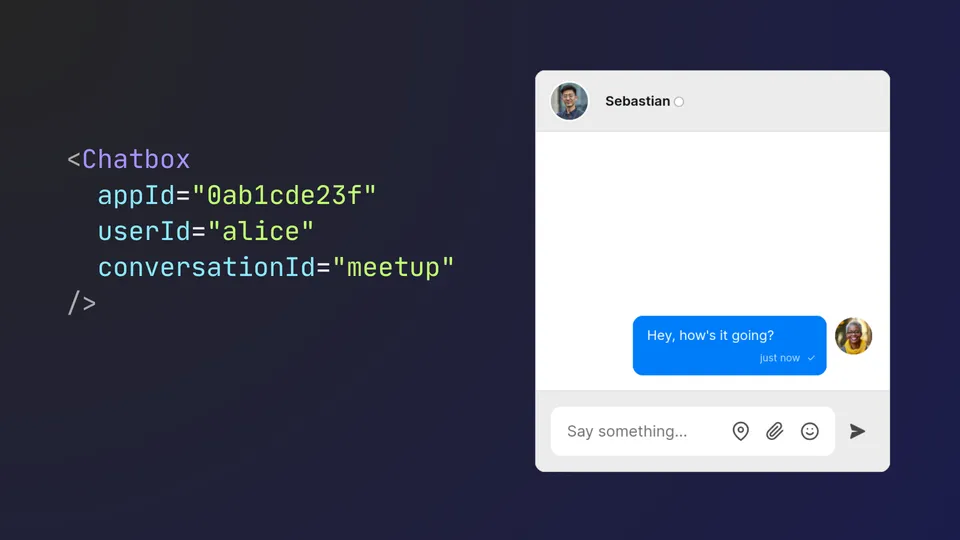
TalkJS, on the other hand, provides a complete chat solution, frontend and backend, in a single package. You get the infrastructure, the code, and a fully functional chat with highly customizable UI, including the design. The UI is forward compatible, so the chat will keep working on future devices, new features, or future browser bugs.
With TalkJS Themes you can customise the TalkJS user interface. From quick tweaks to fonts and colours, to completely changing the markup in certain areas. You could have a light theme, a dark theme, but you might also have themes with UI elements that you only show to a particular subsection of your users.
And it's not all about styling — it's about functionality as well. You can create a Theme that works great for your Slack-style app, mobile messenger, and even a live comment section next to a video livestream.

Notifications
TalkJS provides a robust notification system with advanced features that keep the users in the loop across different platforms. For example, users can reply to the email notification directly or jump back in to the chat platform – either way, their response will safely reach its destination. Stream’s notification system is limited to push notifications.

A Stream Chat alternative for marketplaces
In a marketplace, chat has to keep buyers and sellers on your platform. TalkJS can hide email addresses, phone numbers and links in messages, so a deal doesn’t move somewhere you can’t see it. Once a transaction is complete, you can reveal contact details to one buyer and seller. When a buyer is offline, TalkJS emails them the messages they missed, and their reply to that email lands in the same chat. Our buyer-seller chat page shows how marketplaces set this up.
Customizing the chat UI and branding
With TalkJS you start from a finished chat UI and change as much of it as you need: component props, CSS overrides, single theme components, or a whole custom theme. On Growth and higher, notification emails can come from your own domain, so your users see your brand from the chat to their inbox.
Bottom line
Both TalkJS and Stream provide the tools essential for creating a great messaging experience. If you need AI moderation, Stream includes it only on its Enterprise plan, while TalkJS connects to the AI moderation service you choose on every plan. But If you want a complete chat solution that comes with a fully-featured chat UI, and a robust notification system, then TalkJS is the better option.
Ready to start coding? TalkJS is free for development and testing. You’ll have plenty of time to customize and integrate your chat. You pay when you decide to go live. Try it out!